Long before urban planning and apartment bylaws entered our vocabulary, there was Atithi Devo Bhava. A belief rooted in the Upanishads that taught us something simple and profound: a guest is to be treated like God. Doors stayed open. Extra vessels were pulled out. Rooms were rearranged. And nobody questioned whether there was enough space. Space was simply made.
There was a time when homes were built for this rhythm. Bungalows, courtyard houses, and sprawling family homes absorbed visitors naturally. Summer holidays stretched for weeks. Relatives arrived with trunks, stories, and no return tickets in sight. That world has changed. But the instinct to host has not.
Modern city living has quietly rewritten how homes function. Apartments are designed for efficiency, privacy, and the realities of contemporary life. Children need their own rooms. Work-from-home routines demand quiet corners. Daily schedules are tighter, and space is planned with intention.
Yet culturally, the expectation remains the same. Guests should stay with you. Anything else still carries an unspoken discomfort.
There is a familiar tension here. Suggesting a guest house can sometimes feel like rejection. As if offering a separate space implies distance, hierarchy, or indifference. Popular culture has reflected this discomfort, too. In films and stories, being asked to stay in a guest house is often portrayed as an insult rather than a courtesy.
But this interpretation misses a quieter truth. Hosting has not lost its warmth. It has simply evolved.
At Altezza and Broadstone, the idea of guest accommodation is not positioned as an alternative to hospitality. It is an extension of it.
These guest houses exist within the same residential community. Guests remain close, connected, and included. Families can visit freely. Meals are shared. Time together is uninterrupted. The difference is not emotional distance, but spatial dignity.
A dedicated guest house allows everyone involved to be comfortable. Visiting parents can rest without feeling like they are disrupting routines. Children keep their personal spaces intact. Hosts can remain attentive and present without reorganising their entire home.
This is not about sending guests away. It is about hosting them better.
What makes this approach meaningful is not convenience alone, but consideration.
In Indian culture, guests often hesitate to express discomfort. They adjust quietly. They sleep lightly. They apologise for taking up space. A well-appointed guest house removes that discomfort without removing closeness.
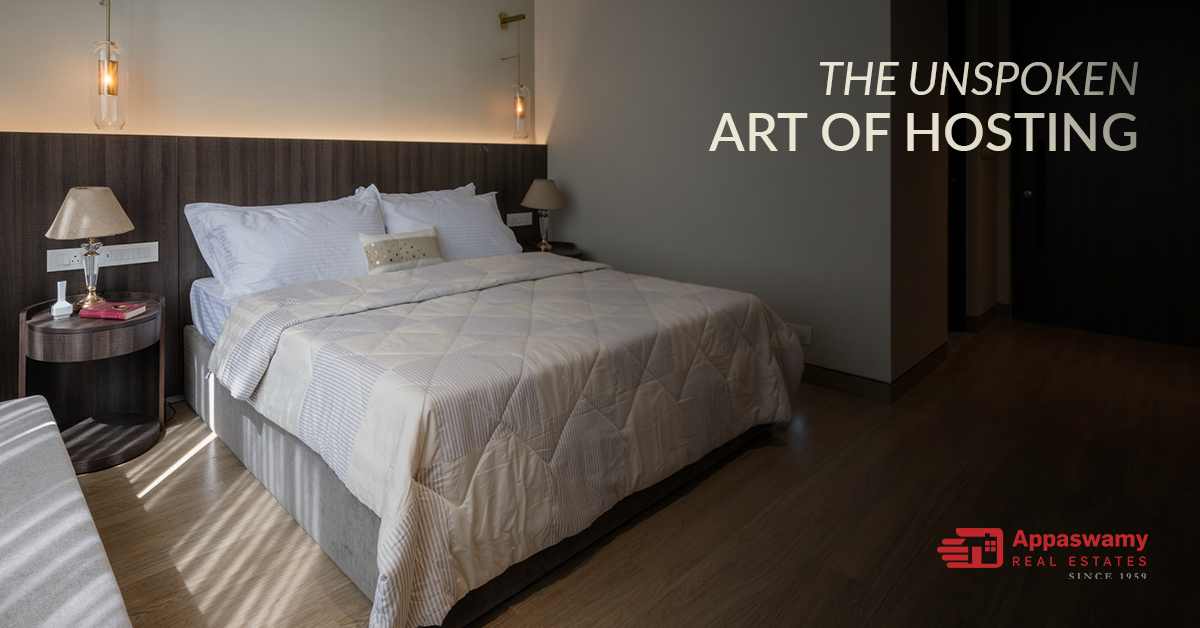
At Altezza and Broadstone, guest accommodations are designed with this sensitivity in mind. Finished and serviced to standards comparable to a well-run three or four-star hotel, these spaces offer privacy, comfort, and dignity. Each room has its own bathroom. Stays can be planned. Visits can extend without anyone feeling like an imposition.
Importantly, these guest houses sit within the same ecosystem as the homes themselves. Guests are not distanced. They are simply given their own space.
Appaswamy has always believed that good residential design supports community without erasing individuality. Guest house living fits naturally into this philosophy. It recognises that modern homes cannot stretch endlessly, but shared spaces can support private living when designed with care.
This is not a rejection of tradition. It is a continuation of it, adapted to how we live today.
Hospitality does not disappear when guests sleep in a different room. It disappears only when thoughtfulness does. And here, thoughtfulness leads the design.
Atithi Devo Bhava was never about where a guest slept. It was about how they were treated.
By allowing guests to stay comfortably within the same community, Altezza and Broadstone preserve the spirit of hosting while respecting modern realities. Families remain close. Bonds remain warm. Homes remain functional.
Mature residential design is not about fitting every function into one apartment. It is about knowing when shared spaces serve everyone better.
14 Apr 2026