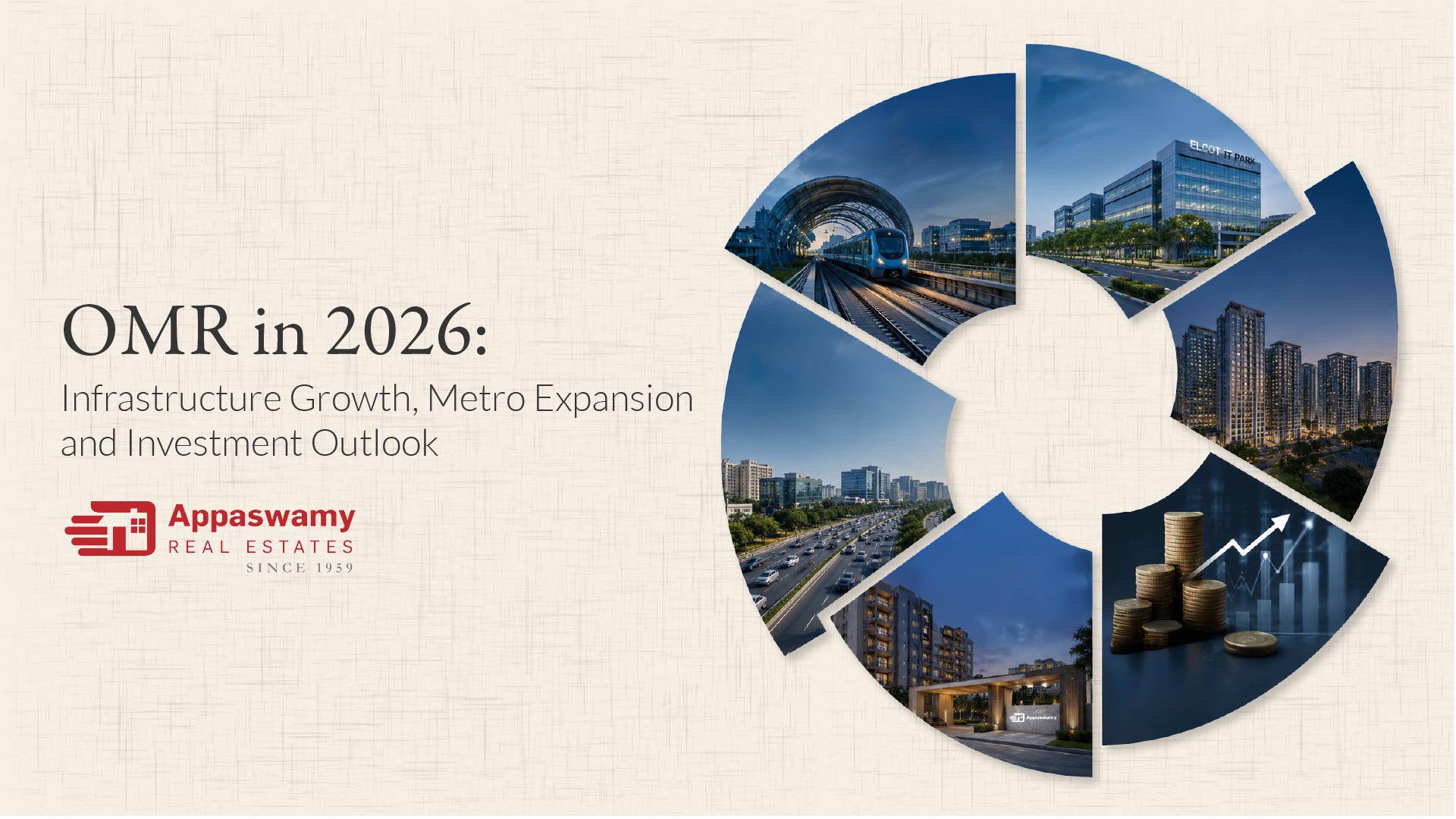
For years, OMR was a corridor defined by its future potential rather than its daily reality. Residents moved here for the rapid growth of the IT sector, but had to navigate years of disruptive roadwork, unpredictable commutes, and delayed transit infrastructure.
The promise of living minutes away from global workplaces and enjoying a self-contained modern lifestyle was clear, but the experience hadn’t fully caught up.
In 2026, that gap is beginning to close. With metro infrastructure taking visible shape and large-scale commercial expansion underway, OMR is entering a phase where its long-promised potential is finally becoming part of everyday life.
The Metro Becomes Visible
The most significant shift is the Chennai Metro Phase 2 Purple Line, which is nearing completion across several key stretches of OMR. Elevated tracks now run across large portions of the corridor from Taramani toward Siruseri SIPCOT, marking one of the largest transport upgrades the area has seen since the IT boom began.
Once operational, the line will dramatically reduce dependence on road travel. For thousands of professionals working along the IT belt, daily travel will no longer be dictated by peak-hour road congestion. The corridor will be connected through a predictable, high-capacity transit system linking the technology district with the rest of Chennai.
In practical terms, this change will restore something many residents value deeply: time.
OMR is also undergoing a second transformation. What began as an IT corridor is now evolving into a major hub for Global Capability Centres (GCCs). Multinational companies are increasingly establishing large operational bases in Chennai, and OMR has emerged as the preferred location for these investments.
Industry reports indicate that the city could add nearly 13 million sq. ft. of premium office space by the end of 2026, with a significant portion concentrated along the OMR corridor. These developments are attracting a growing population of highly skilled professionals who prefer to live close to their workplaces.
As employment density increases, supporting infrastructure follows. Schools, hospitals, restaurants, and retail centres are expanding to match the needs of a more globally mobile workforce.
In real estate markets, the most significant price shifts often occur just before major infrastructure becomes fully operational. Once stations open and transit becomes part of daily life, demand tends to accelerate rapidly.
OMR currently sits at that transitional moment. The infrastructure is visible and largely built, yet the full economic impact will follow once the system begins operating.
While Chennai's overall real estate market maintains steady baseline growth, key nodes along OMR, such as Perungudi and Sholinganallur, are outperforming the city average. Capital values here have accelerated by 7% to 9% annually, reflecting localized demand well before the first metro train runs.
OMR continues to lead Chennai in rental demand, particularly within premium gated communities. The concentration of technology companies ensures a consistent inflow of professionals seeking high-quality housing close to their offices.
While average rental yields across Chennai often hover near 3%, premium developments along OMR frequently achieve 5% to 6% yields, supported by this sustained employment ecosystem.
Projects that combine professional property management, well-maintained green spaces, and reliable infrastructure also tend to command higher resale premiums compared to standalone buildings.
Appaswamy’s developments along OMR are positioned within this evolving landscape, each reflecting a different interpretation of the corridor’s growth.
Altezza (Kottivakkam) integrates expansive views with its signature vertical garden concept, extending lush greenery up to the rooftop. Its proximity to upcoming metro connectivity positions it within one of the most dynamic nodes of the corridor.
Wingfield (Kottivakkam) sits at the intersection of two distinct environments, the energy of OMR and the coastal calm of the ECR belt, offering a quieter residential experience while remaining connected to the city’s technology district.
Splendour (Semmancheri) reflects the corridor’s expansion further south, where growing employment zones and infrastructure upgrades continue to reshape residential demand.
After more than a decade of transition, OMR is approaching a point of completion that few corridors in Chennai have experienced at this scale.
With the infrastructure largely set and the employment ecosystem rapidly expanding, the resulting surge in residential demand is already transforming the corridor. For buyers and investors, this is typically the phase where decisions carry the most long-term impact. Not after everything is fully operational, but just before it becomes part of daily life.
07 Apr 2026