Chennai is not a city that announces its history loudly. You come to understand it slowly, through familiar streets, long-standing institutions, and places that have existed in your peripheral vision for years. Some sites carry memories not because they are grand monuments, but because they were part of everyday life.
In a city like this, land, apart from being a plot on a map, also holds context, familiarity, and meaning built over decades. At Appaswamy, recognising that context is where responsible development begins.
Appaswamy’s approach to land selection starts with a simple question: what did this place represent before us, and can its next chapter be written without erasing that relationship?
This requires patience and restraint. Sites are studied not only for scale, access, or development potential, but for their role in the city’s social, cultural, or everyday history. The goal is not to preserve structures at all costs, but with cities evolving, buildings must evolve with them. What matters is preserving meaning.
Across decades, Appaswamy has worked with several such sites, each with its own story. While the projects differ in scale and context, they share a common approach: acknowledging what stood there before, and building forward with intent.
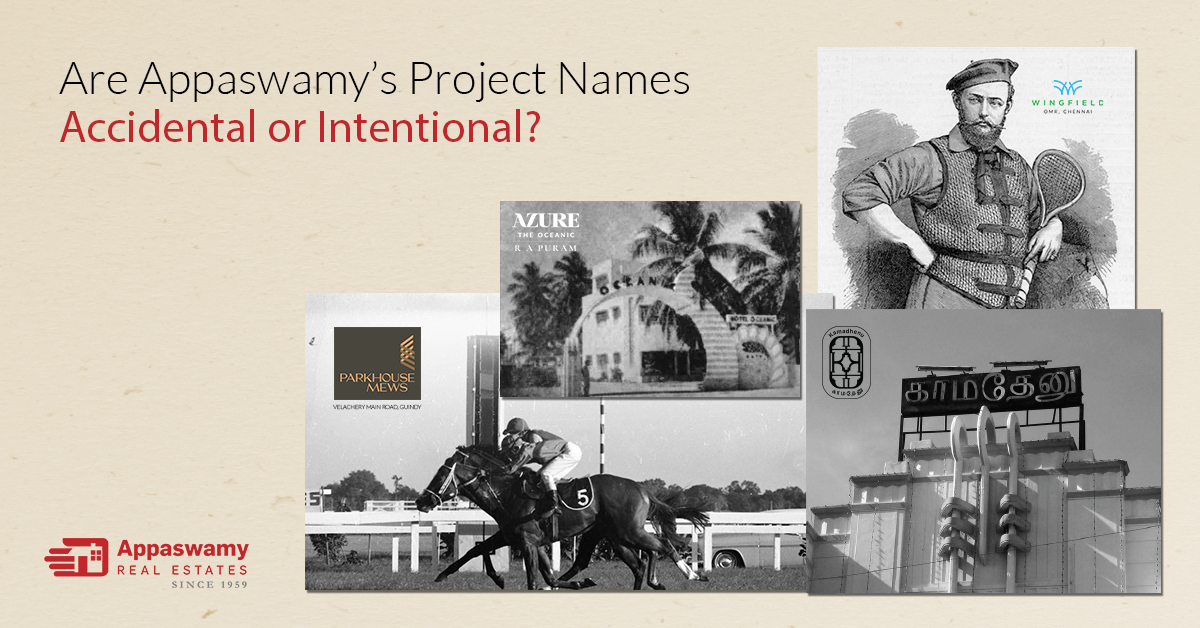
Azure The Oceanic, Santhome
The site that now houses Azure The Oceanic was once home to the Oceanic Hotel, a landmark of mid-20th-century Madras. At a time when the city was opening itself to new ideas, the Oceanic Hotel stood out for being ahead of its era.
Today, Azure The Oceanic occupies the same coastal location. While its function has shifted from hospitality to residential living, the site’s identity as a forward-looking address remains intact. What once symbolised progress and modernity has not disappeared. It has evolved.
Parkhouse Mews, Guindy
Parkhouse Mews stands on land that was once part of the Madras Race Club ecosystem. This area played a significant role in the city’s sporting and colonial history.
The transition from working stables to a residential enclave marks a clear change in use. Yet, the calm, openness, and measured character of the land continue. A place once organised around movement now becomes a place designed for intentional living.
Kamadhenu, Mylapore
Few sites in Chennai reflect layered continuity as clearly as Kamadhenu.
Through each phase, the site remained present in Mylapore’s collective memory. The decision to retain the name Kamadhenu is not about nostalgia. It is an acknowledgement that the name never left the city’s consciousness. It simply changed form.
What exists today is not reinvention, but continuation.
Wingfield, OMR
Not all histories are widely known, but that does not make them insignificant.
By retaining the name Wingfield, the project acknowledges a simpler chapter in the land’s story. Even modest histories deserve recognition, especially in a city growing as rapidly as Chennai.
Each of these locations was part of the city’s everyday fabric. They were known, familiar, and lived with, even if not always celebrated. Appaswamy’s responsibility lies in recognising that familiarity and building with it, rather than replacing it entirely.
At Appaswamy, development is approached as an act of continuity. The intention is not to hold on to history sentimentally, nor to erase it in the name of progress. It is to allow what came before to inform what comes next.
Homes built on land with meaning tend to feel more rooted. They carry relevance not because of marketing language, but because they begin with an understanding of place.
When development respects what stood there before, what comes next often lasts longer.
31 Mar 2026