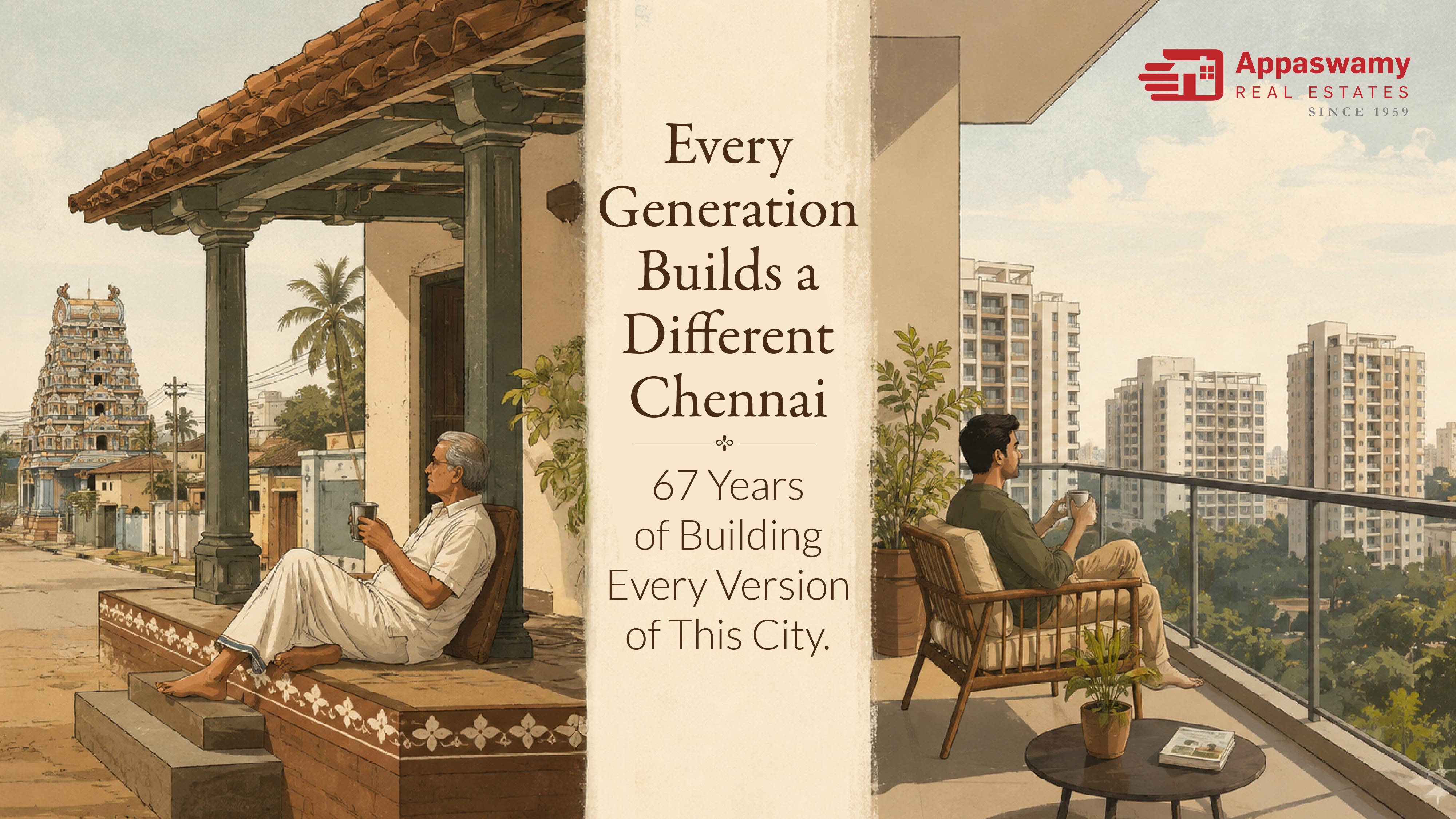
Chennai can be read through its neighbourhoods. Mylapore carries centuries of cultural life. R.A. Puram opens towards the coast and the Adyar River. Guindy grew around industry and now sits alongside major business districts and the Guindy National Park. OMR represents a newer Chennai shaped by technology, employment and a rapidly expanding urban corridor.
Each neighbourhood reflects a different stage in the city's growth, and each continues to evolve with the people who live and work there.
The city is already planning its next chapter. In July 2026, the Chennai Metropolitan Development Authority began stakeholder consultations for its Third Master Plan, which will guide the Chennai Metropolitan Area through 2046, bringing housing, transport, infrastructure, the environment and economic growth into a single conversation.
The way Chennai grows leaves its mark on the way people live. Its neighbourhoods tell that story particularly well.
Mylapore's character comes from the life that has accumulated around its streets over generations. Kapaleeshwarar Temple, the Music Academy, Nageshwara Rao Park and the shopping streets around the neighbourhood create an environment where culture remains woven into everyday life.
Kamadhenu sits within this established fabric, close to the landmarks and transport links around Luz Corner and Mylapore. Its contemporary residential setting draws from the character of its surroundings, giving residents a modern home within one of Chennai's most recognisable cultural neighbourhoods.
Here, the city carries its history forward through everyday life.
R.A. Puram has a geography that gives it a distinct relationship with the city. The Bay of Bengal, Adyar River and Tholkappia Poonga sit alongside schools, cultural institutions and historic places of worship, creating a neighbourhood shaped as much by its landscape as by its urban setting.
Azure The Oceanic stands on South Canal Bank Road, on the site of the former Oceanic Hotel. Its eastern orientation opens towards the Bay of Bengal, with the Adyar River and Tholkappia Poonga forming part of the surrounding landscape. Expansive balconies and large glass openings bring daylight and the changing views into the residences.
Here, the eastern edge of Chennai becomes part of the experience of home.
Guindy represents another chapter in Chennai's development. The Guindy Industrial Estate, established in 1958, became the first industrial estate in Tamil Nadu, helping establish the neighbourhood as an important centre for industry and employment. Today, that legacy sits alongside offices, institutions, transport corridors and the extensive greenery of Guindy National Park.
Malkoha stands on Velachery Road opposite the park, with access to Guindy Metro, Anna Salai, GST Road, Rajiv Gandhi IT Expressway and IIT Madras. Its balconies open towards the surrounding green landscape, while rainwater harvesting, treated-water reuse and solar-powered common areas form part of its resource systems.
The result is a home positioned at an interesting meeting point in Chennai: established urban infrastructure on one side, a remarkable expanse of greenery on the other.
Further south, OMR represents a newer phase of the city's growth, shaped by technology, employment and the expansion of Chennai's southern corridor. Major employment centres such as TIDEL Park and SIPCOT IT Park at Siruseri have helped create an urban landscape where workplaces, homes and supporting infrastructure continue to develop alongside one another.
Altezza responds to this newer urban scale through its idea of an ecological vertical village. Its Parco, Giardino and Stratos towers bring landscape into a high-rise setting through vertical gardens, sky parks, a Crown Garden and a Roof Garden. Rainwater harvesting, recycled water for gardens, solar-powered common-area lighting and a composter form part of its environmental systems.
Here, the city moves upwards, and the idea of landscape moves with it.
Mylapore, R.A. Puram, Guindy and OMR have grown in different directions, shaped by the cultural, geographical, industrial and economic forces around them. Their identities continue to evolve as Chennai itself changes.
Appaswamy has built across these different chapters of the city, with homes that respond to the character of their respective locations.
That perspective comes from staying close to one city for generations. 67 years of building in Chennai means understanding the city as it has been, recognising the city as it is, and continuing to build for the city it is becoming.
25 Aug 2026


