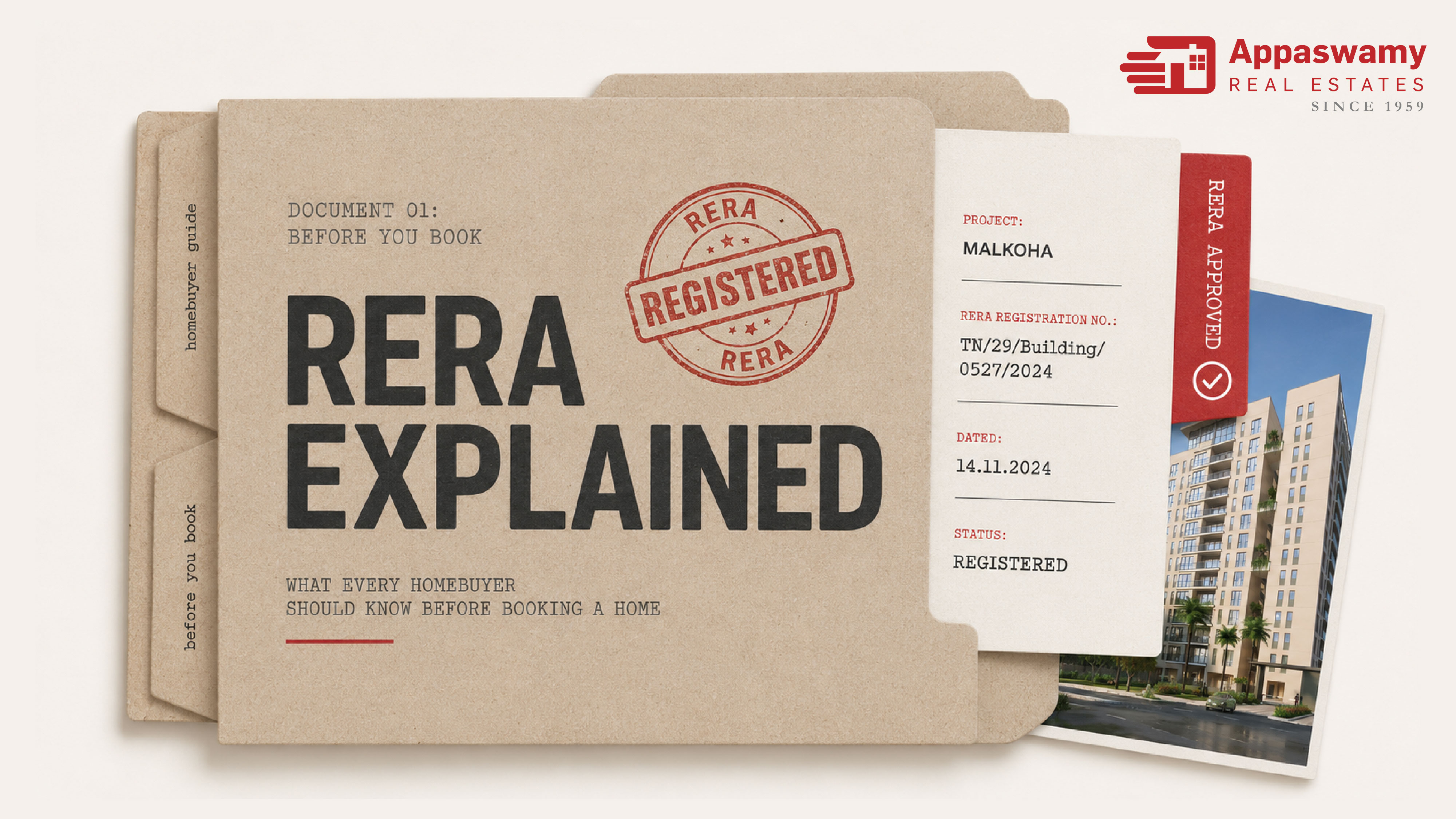
Every home purchase runs on a small act of faith. A brochure shows a beautiful render, a sales conversation promises a possession date, and a buyer signs on, mostly trusting that everything said out loud will hold up later. RERA exists to close that gap between what's promised and what's true, and understanding it turns that leap of faith into something you can verify.
Here's the part most people miss: every RERA-registered project has a number, and that number works as a key. Type it into your state's RERA portal, and the project's entire official record opens up, who's developing it, what's been approved, what the building is supposed to include, and by when. Before you commit a significant amount of money to a home, that's worth five minutes.
Start with something as simple as size. You've probably heard the term "carpet area" thrown around without much explanation. RERA defines it precisely, and requires every promoter to disclose it. It excludes things like external walls and balcony space, giving you the usable area of your home, an honest number rather than an inflated one. The next time you're comparing two apartments, don't ask how many square feet each one is. Ask what the RERA carpet area is, and how it compares to the number being quoted to you.
Your money is protected in a similar manner. Most people have heard of an "escrow account," even if they've never fully understood what it does. RERA requires that 70% of everything a promoter collects from buyers be kept in a dedicated account meant only for that project's land and construction costs. Withdrawals are tied to construction progress, and need to be certified by an engineer, an architect and a chartered accountant. In Tamil Nadu, this protection got stronger from 1 January 2026, with a three-account structure that tracks exactly how collected money moves, from the moment it comes in to the moment it's spent. Your booking amount sits in an account ring-fenced specifically for the home you're paying for, not the promoter's general funds.
There's also a limit on how much a promoter can ask you for before things get formal. Before signing an Agreement for Sale, a promoter can only collect up to 10% of your home's cost as an advance. That agreement, once signed, spells out your possession date, the payment schedule, the specifications you're paying for, and what happens if any of it is missed. Of every document in this transaction, it's the one worth reading twice.
Possession date matters more than any other, because it's the one most buyers treat loosely until it's already late. RERA requires that development timelines be disclosed as part of the registered record. If a project runs behind, the law gives you two options: exit and get your money back with interest and compensation, or stay on and receive interest for every month of delay.
The protection doesn't end at handover. A structural issue or a defect in workmanship can be brought to the promoter's attention for up to five years after you take possession, and they're required to fix it, free of charge, within 30 days. If they don't, compensation follows. Your builder stays on the hook long after the keys change hands.
If something does go wrong along the way, RERA backs its record-keeping with a dispute resolution process. Complaints can be filed with the Real Estate Regulatory Authority, and there's an Appellate Tribunal for appeals. If a promoter makes a false claim in an advertisement or a model apartment that ends up costing you money, the law provides for compensation there too.
So what does this look like in practice? Take any project you're considering, including one of ours, and use the registration number to look up who's actually behind it. Every Appaswamy development is RERA-registered, with its certificates, specifications, approvals and timelines publicly available on the RERA portal for anyone to check. That's the whole exercise: find the number, read what's been promised in writing, and let the record speak before you sign on the dotted line.
21 Jul 2026


